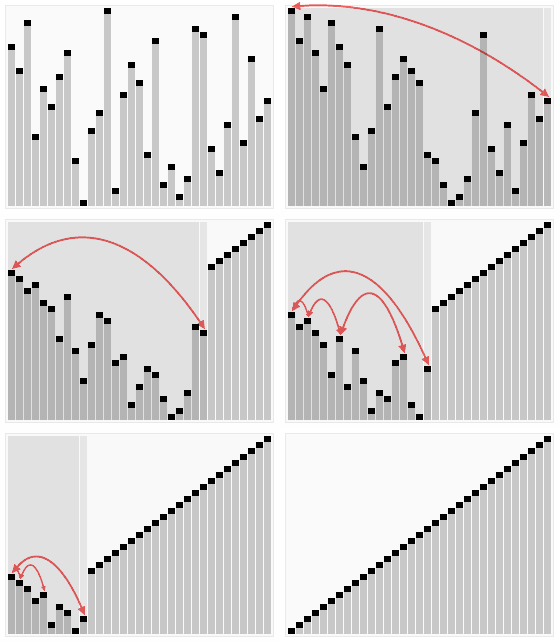
Heap Sort
S
M
D
p
O
A
R
P
# Algorithm: Heap-Sort
# Time-Complexity: O(nlogn)
def heap_sort(array)
  array_size = array.size
  adjusted_array = [nil] + array
  (array_size / 2).downto(1) do |i|
    adjusted_down(adjusted_array, i, array_size)
  end
  while array_size > 1
    adjusted_array[1], adjusted_array[array_size] = adjusted_array[array_size], adjusted_array[1]
    array_size -= 1
    adjusted_down(adjusted_array, 1, array_size)
  end
  adjusted_array.drop(1)
end

# Method to adjust heap in downward manner
def adjusted_down(adjusted_array, parent, limit)
  top = adjusted_array[parent]
  while (child = 2 * parent) <= limit
    child += 1 if (child < limit) && (adjusted_array[child] < adjusted_array[child + 1])
    break if top >= adjusted_array[child]

    adjusted_array[parent] = adjusted_array[child]
    parent = child
  end
  adjusted_array[parent] = top
end

if $0 == __FILE__
  puts 'Enter a list of numbers separated by space'

  list = gets.split.map(&:to_i)
  p heap_sort(list)
end
About this Algorithm
Problem Statement
Given an unsorted array of n elements, write a function to sort the array
Approach
- Build a max heap from the input data.
- At this point, the largest item is stored at the root of the heap. Replace it with the last item of the heap followed by reducing the size of heap by 1. Finally, heapify the root of tree.
- Repeat above steps while size of heap is greater than 1.
Time Complexity
O(n log n) Worst case performance
O(n log n) (distinct keys)
or O(n) (equal keys) Best-case performance
O(n log n) Average performance
Space Complexity
O(1) Worst case auxiliary
Example
Input data: 4, 10, 3, 5, 1
        4(0)
       /   \
    10(1)   3(2)
   /   \
5(3)    1(4)

The numbers in bracket represent the indices in the array
representation of data.

Applying heapify procedure to index 1:
        4(0)
       /   \
   10(1)    3(2)
   /   \
5(3)    1(4)

Applying heapify procedure to index 0:
       10(0)
       /  \
    5(1)  3(2)
   /   \
4(3)    1(4)
The heapify procedure calls itself recursively to build heap
in top down manner.